 Tom Greenaway
Now I can do anything – so what's worth doing?
"We may need to develop the taste to actually not use technology to its maximum." - Bill Gates
I watched an excellent interview of Bill Gates on the Verge recently and that quote above really jumped out at me. And I've been noodling on it and a bigger topic in the last few months as AI tools have exploded in coding capability.
There is a sort of seductiveness of technology and especially the latest coding agents powered by Gemini Neon and Antigravity. It feels like anything we can imagine we can simply 'will' into existence now. It feels any software I ever wanted to build I now can. And probably this even extends into the space of "vibe building" hardware even.
As a result, I think the whole world is generating more code right now than at any other point in human history (I certainly am generating more than ever before.)
My latest demo
A few weeks ago I recreated Paris in 3D using Gemini Argon. It was super fun!
At the beginning all I planned to build was the city buildings, monuments, and the Paris metro system. But once I achieved that I couldn't help but want to add more:
- Why not a historical walking tour simulation?
- Or a questionnaire for practicing for the French nationality interview?
- Why not add 'les grandes lignes' (the big train stations and their railways in Paris) as well?
- Or the ability to lift the metro system out of the ground for better visibility? A weather system? A simulation system for marathons similar to Race Condition?
Why stop at Paris!? I could add Sydney, Rio, San Francisco… New York!
And soon after that, my colleagues started request cities: “Add Zurich please” … “And Warsaw!” … “It's easy right? It’s just vibe coding…”
They were right, it was so easy and the reward was so instantaneous the entire experience was becoming – as I described earlier – all too seductive. Eventually I had to say ‘no’ to my colleagues but even more importantly, I had to say ‘no’ to myself.
And then I remembered a recent tweet:
"Give a man a fish and you feed him for a day. Teach a man to Claude Code and you financially ruin him with distracting side projects for the rest of his life."
All of this is to say… when code is free, feature creep is automatic.
The old constraints
For the entire history of software, effort and time was the natural brake pedal on bad ideas. Heck, it was the natural brake pedal on all ideas – it never guaranteed only bad ideas were blocked.
And so to protect our sanity, we engineers would calculate the trade offs of adding features, because not all ideas were equal in value.
But that selectivity of features we added often made the products better. The old ‘less is more’ approach meant that products were naturally tighter and more focused.
Because the truth is that focus wasn't just a pragmatic compromise between product managers and software engineers. Focus is something users actually appreciate.
Just like minimalism in art isn’t due to constraints of effort and time of the artist. The truth is that it’s an aesthetic approach and a genuine philosophy.
When a product does one thing with total clarity, you feel it immediately. Every extra setting, mode, or "bonus" feature bolted on doesn't just add to the codebase, it dilutes the idea and soul of the product.
Which leaves us with a curious question in 2026:
If effort & time is no longer the constraint – if I can build almost anything – how do I know what is actually worth doing?
Let’s face it – there’s still plenty of bad ideas out there. They’re not suddenly all equal in value. And just because human effort is reduced – token cost and time (be it agent work time or human supervision and review time) do still exist.
Minimalism is evergreen
When I put on my game developer hat and let my mind wander over potential games that could AI tools could let me build now, my imagination naturally goes a little wild.
So how would I structure my time if I were to make a new game now? Back in 2019 I wrote down my 10 Lessons from Duet, and looking back at that list today, one takeaway has aged well: cut all overlapping features — reduce to the minimum viable gameplay.
Duet was a minimalist game in which you just controlled two vessels spinning on a ring, flying through space. There were no power-ups or skill trees.
And all of that was by design, we stripped everything back on purpose until the entire game could be understood from five feet away, looking over someone's shoulder on a train. Even the story of the game worked the same way – the less we explicitly explained, the more room we left for the player's own imagination.
For me, game design was always about starting from a single core idea and building outward – keeping only what serves that core, and throwing away everything that competes with it.
So maybe the answer to "what's worth doing when you can do anything?" is to start by identifying what the core of your product is meant to be and hold that north star even more tightly than ever before.
Time was a constraint for all projects but the best products were the ones that intentionally constrained themselves by maintaining a relentless discipline of focus. Time scarcity just used to enforce that discipline for us for free. Now that the guardrail is gone, the discipline has to come entirely from us.
Just say ‘No’
When the world – and your own tools – can ask and offer more and more of you every single day, the most important skill left isn't how fast you can say yes.
It's the power to say ‘No’.
Apple was famously built on this exact principle. I remember reading that Tim Cook described Steve Jobs simply as the most focused person he had ever met in his life.
Steve used to tell his teams that people think focus means saying yes to the thing you've got to focus on, when it actually means saying no to the hundred other good ideas that pop up along the way. He was just as proud of the things Apple didn't do as the things they did.
Saying no to a terrible idea is easy. What's brutally hard – especially now, when an AI agent can prototype a "pretty good idea" for you in ten minutes – is looking at a working feature that took almost no effort to generate, realising it complicates the soul of what you're making, and hitting delete.
Techniques for focus
This is all good in theory, but how can we actually apply this? At its heart, this is the oldest problem in product management – only now it's running at 10x speed.
A few practical filters that help me decide when to cut:
- The “one sentence” test: Write down what your project is in a single sentence. If a new feature makes you add "…and it also…" to that sentence, cut it.
- The "over the shoulder" test: Borrowed straight from Duet – if adding a button, mode, or panel stops someone from grasping what the thing does in five seconds, it's noise, not value.
- Count the maintenance & attention cost, not the build cost: Coding agents drive implementation cost close to zero, but they don't reduce cognitive cost for your users. Every new toggle still steals attention, complicates your UI, and adds another surface to explain and keep coherent for your users.
- Keep a "not now" folder: Saying no is much easier when it doesn't feel permanent. Drop shiny bonus features or side ideas into a separate notes file instead. If you still care about an idea a week later, that’s a good sign.
- Prototype to throw away: Because code is cheap, it's totally fine to let an agent build a wild idea on a branch just to feel it out. The trick is treating that prototype as an experiment to evaluate – and being willing to delete the whole branch if it dilutes the core.
Conclusion
We now live in a world of infinite code, infinite content and near zero friction to generate more of both.
Which means we also live in an attention-starved world. Your users don't have more hours in their day just because your coding agent is working for you overnight. Their attention is still finite, fragile, and easily overwhelmed.
When anyone can build anything, building everything too easily becomes the default behaviour.
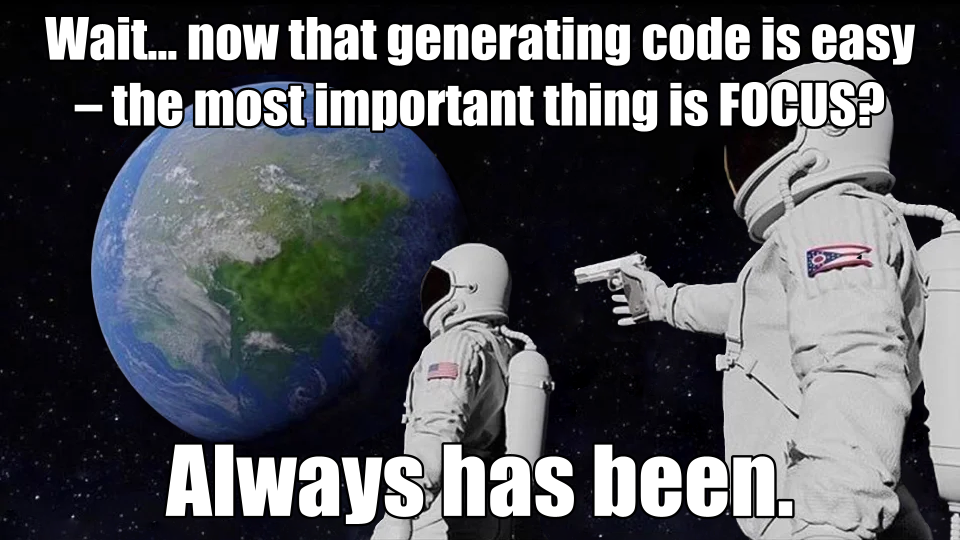
And now – more than ever – focus is everything.
Article published on: